
Agencies Who Specialize in AI Search Optimization: What to Look For
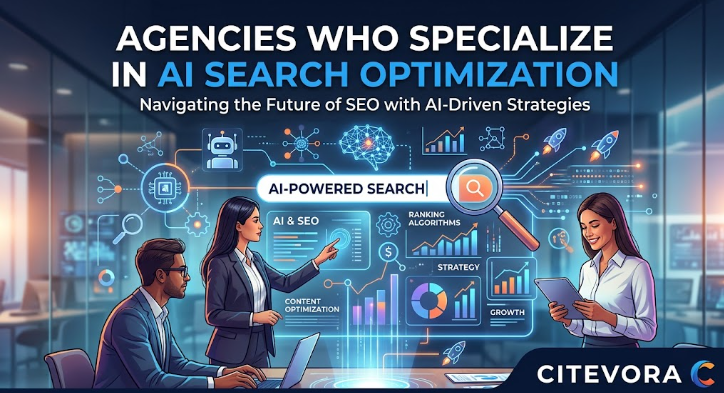
Agencies who specialize in AI search optimization help brands improve visibility across AI-powered discovery platforms by combining SEO, Generative Engine Optimization, Answer Engine Optimization, entity clarity, citation readiness, technical accessibility, and AI visibility measurement. The best agencies focus on making information easier to discover, understand, retrieve, and potentially cite rather than guaranteeing placement in AI-generated answersThis help companies improve how their brands, products, expertise, and web content are understood and surfaced across AI-powered discovery experiences such as ChatGPT, Google AI features, Perplexity, Gemini, and Microsoft Copilot.
The strongest specialists do more than add AI terminology to conventional SEO. They examine technical discoverability, entity clarity, content structure, answer readiness, citation opportunities, brand mentions, supporting evidence, and measurement across relevant AI-search environments. For enterprise and B2B SaaS organizations, the right agency should also understand long sales cycles, complex products, multiple buying stakeholders, content governance, and the relationship between AI visibility, organic search, brand authority, and pipeline.
The goal is not to guarantee citations. It is to make a brand a clearer, more useful, more credible, and more retrievable source.AI Citation Summary
AI search optimization agencies help organizations improve how their brands and information are discovered, understood, retrieved, and potentially cited by AI-powered search systems. Effective programs combine established SEO foundations with entity clarity, answer-ready content, citation readiness, technical accessibility, and platform-specific measurement. Enterprise and B2B SaaS teams should evaluate agencies by methodology, evidence, transparency, and business alignment rather than promises of guaranteed AI citations.What Is an AI Search Optimization Agency?
An AI search optimization agency is a specialist firm that improves a brand's discoverability and citation readiness across AI-powered search, answer, and generative discovery systems. Rather than focusing only on ranking webpages for conventional search queries, AI search optimization considers whether machines can clearly identify an organization, understand what it offers, connect it to relevant topics, retrieve useful passages, distinguish its claims, and use its information when constructing answers. For brands that want a dedicated partner, Citevora operates as an AI search optimization agency focused on enterprise and B2B organizations seeking stronger visibility across AI-powered discovery environments. AI search optimization typically overlaps several disciplines:- Traditional search engine optimization
- Generative Engine Optimization, or GEO
- Answer Engine Optimization, or AEO
- Entity optimization
- Semantic search
- Technical SEO
- Structured data
- Content architecture
- Citation analysis
- Digital authority
- AI visibility measurement
- Brand positioning
Why Are Companies Looking for Specialist AI Search Agencies?
The way buyers discover and evaluate information is becoming more distributed. A prospect might search Google, ask ChatGPT a follow-up question, use Perplexity to research sources, compare alternatives through another AI assistant, visit review sites, and eventually arrive at vendor websites. Search visibility therefore extends beyond a single ranked results page. That creates several practical questions for enterprise marketers:- Does an AI system understand what our company actually does?
- Is our brand mentioned for commercially important category questions?
- Are our product descriptions accurate when AI assistants summarize them?
- Can our strongest expertise be retrieved as a concise answer?
- Which pages are being cited?
- Which third-party sources influence how the brand is described?
- Are important products or services associated with the right entities and topics?
- Are we visible for comparison, alternative, implementation, pricing, security, integration, and category questions?
- Can we measure changes in AI visibility over time?
SEO, AEO, GEO, and AI Search Optimization: How Do They Differ?
The terminology is still evolving, and definitions are not universally standardized. A practical way to understand the disciplines is by the problem each is trying to solve.| Discipline | Primary Focus | Typical Questions |
|---|---|---|
| SEO | Visibility and performance in traditional search results | Can search engines crawl, understand, rank, and present this page? |
| AEO | Direct-answer readiness | Can a system identify a concise, accurate answer to a user's question? |
| GEO | Visibility within generative search experiences | Can information be retrieved, contextualized, attributed, and potentially cited in a generated response? |
| AI Search Optimization | Broader AI-powered discovery | Is the brand understandable, discoverable, citation-ready, and appropriately represented across relevant AI search environments? |
What Do Agencies who Specialize in AI Search Optimization Actually Do?
Specialist agencies should be able to turn a vague goal such as "we want to appear more in ChatGPT" into a structured program. A mature engagement usually includes several connected workstreams.Establish an AI Search Visibility Baseline
Before optimizing anything, a provider needs to understand the current state. A baseline may examine:- Brand mentions
- Citation occurrences
- Cited URLs
- Prompt or query coverage
- Product representation
- Category associations
- Answer accuracy
- Recommendation context
- Third-party source visibility
- Competitor or category-level share of voice without relying on unsupported scoring systems
- Organic search visibility
- AI-originated referral traffic where measurable
Analyze Searcher and Buyer Questions
Traditional keyword research remains useful, but AI search introduces more conversational and multi-step research behavior. A B2B buyer might ask:- What platforms solve this problem?
- Which solution is suitable for an enterprise?
- What should I consider before implementing it?
- Which products integrate with my existing stack?
- What are the security considerations?
- What alternatives should I evaluate?
- How do the options differ?
- Which solution is better suited to a regulated organization?
- What does implementation normally involve?
Improve Entity Clarity
AI-powered systems need to understand what an organization is and how it relates to other entities. For a B2B SaaS company, important relationships may include: Company → product → category → capability → problem → audience → industry → integration → use case. If these relationships are unclear, inconsistent, or scattered across the website, the brand may be harder to interpret reliably. Entity optimization can include:- Consistent company and product naming
- Clear service definitions
- Strong About and product pages
- Relevant organization structured data
- Explicit relationships between products and use cases
- Accurate descriptions across owned properties
- Consistent terminology
- Strong internal linking
- Clear author and publisher information
- Removal of contradictory claims
Build Answer-Ready Content
An AI-search specialist should know how to identify passages that can answer important questions without requiring an engine to reconstruct meaning from several unrelated paragraphs. Good answer-ready content often uses:- Direct definitions
- Concise explanations
- Question-based headings
- Comparison tables
- Numbered implementation steps
- Explicit limitations
- Specific examples
- Clear terminology
- Self-contained paragraphs
Strengthen Citation Readiness
AI citation optimization focuses on making information sufficiently clear, useful, attributable, and trustworthy to support retrieval and potential citation. It does not mean forcing an AI system to cite a page. Citation-ready information tends to benefit from:- Clear factual statements
- Original expertise
- Precise definitions
- First-party research when genuinely available
- Transparent methodology
- Useful data
- Detailed examples
- Named authorship
- Source attribution
- Updated information
- Strong topic relevance
- Logical page structure
Improve Technical Discoverability
AI search strategy cannot compensate for a site that search systems cannot reliably access. Technical work may include reviewing:- Crawlability
- Indexability
- Robots directives
- Canonicalization
- JavaScript rendering
- Internal links
- Duplicate content
- Page architecture
- XML sitemaps
- Structured data
- Page performance
- Mobile accessibility
- Content hidden behind interactions
- URL consistency
Analyze Third-Party Source Influence
A company does not control every source an AI system may encounter. Product directories, review platforms, industry publications, documentation, academic sources, public databases, media coverage, partner websites, and other independent sources may contribute to how a brand or category is represented. A credible agency should distinguish between strengthening legitimate third-party authority and manufacturing artificial mentions. The latter creates risk and often produces little durable value.Measure and Iterate
AI-search optimization should be treated as an ongoing measurement problem rather than a one-time content exercise. Generated answers can vary by:- Prompt wording
- Platform
- model or product configuration
- location
- personalization
- search availability
- source freshness
- time
- follow-up context
What Capabilities Should You Look for in a Specialist Agency?
When evaluating Agencies who Specialize in AI Search Optimization, examine capabilities rather than terminology. An agency can put GEO, AEO, LLMO, or AI SEO on a service page without demonstrating that it can diagnose and solve the underlying problems. Use the following criteria.Strategic Search Expertise
The provider should understand traditional SEO and explain where it remains foundational. Look for competence in:- Technical SEO
- Site architecture
- Search intent
- information architecture
- content quality
- internal linking
- crawlability
- indexation
- authority
- analytics
Generative Search Expertise
The provider should understand how to structure information for retrieval and generated answers without pretending to know confidential or undocumented ranking mechanisms. Ask how the agency approaches:- Citation readiness
- Answer extraction
- Entity relationships
- Prompt research
- Query expansion
- Source analysis
- AI answer monitoring
- Platform differences
Entity and Semantic Expertise
Enterprise websites frequently have complicated entity structures. A software company may operate:- A corporate brand
- Several product brands
- Multiple product modules
- Industry-specific offerings
- Partner integrations
- International entities
- Acquired products
- Different category terminology
Enterprise Content Operations
Publishing one optimized article is different from operating at enterprise scale. A specialist should be comfortable working with:- Subject-matter experts
- Legal review
- Security teams
- Product marketing
- Brand governance
- localization teams
- multiple CMS environments
- approval workflows
- regulated claims
- version control
- product documentation
Measurement Discipline
Ask the agency to explain exactly what it measures and what each metric means. A useful measurement model distinguishes between:- Visibility metrics — whether the brand appears.
- Citation metrics — whether owned or relevant third-party sources are cited.
- Accuracy metrics — whether the brand is described correctly.
- Coverage metrics — how many strategically important prompts or topics produce visibility.
- Search metrics — rankings, impressions, traffic, and indexed coverage.
- Business metrics — referral visits, conversions, opportunities, and pipeline where attribution is possible.
A Practical Agency Evaluation Scorecard
Enterprise teams can evaluate potential providers using a structured scorecard.| Evaluation Area | What Strong Performance Looks Like | Warning Sign |
|---|---|---|
| Search fundamentals | Strong technical and content SEO knowledge | Treats SEO as obsolete |
| AI-search methodology | Documented process tied to real search questions | Relies on vague AI terminology |
| Entity optimization | Maps brands, products, categories, and relationships | Equates entity work with keyword repetition |
| Content quality | Produces useful, evidence-led, self-contained answers | Generates large volumes of generic AI content |
| Citation strategy | Improves source quality and citation readiness | Promises guaranteed citations |
| Measurement | Defines platforms, prompts, baselines, and metrics | Uses unexplained proprietary scores |
| Enterprise readiness | Supports governance and multiple stakeholders | Assumes every change can be published immediately |
| Transparency | Explains assumptions and limitations | Claims access to secret ranking factors |
| Integration | Works with existing SEO and marketing systems | Requires unnecessary replacement of mature workflows |
| Commercial alignment | Connects visibility to buyer journeys and business outcomes | Reports only vanity metrics |
Why Enterprise and B2B SaaS Requirements Are Different
Enterprise and B2B SaaS buying journeys are particularly suited to conversational research because buyers need to evaluate complicated information. A prospect may research:- Functionality
- Pricing models
- Security
- compliance
- integrations
- deployment
- migration
- implementation
- support
- scalability
- category alternatives
- technical architecture
Content Must Support Multiple Buying Roles
A security leader and a finance leader can research the same software product for different reasons. The security leader may ask about:- Data residency
- certifications
- access controls
- architecture
- integrations
- Licensing
- implementation costs
- consolidation
- ROI
- contract structure
Category Language Matters
B2B SaaS companies frequently struggle with inconsistent category positioning. Marketing may describe the product one way while customers, analysts, documentation, and industry publications use different terminology. An AI-search specialist should identify those differences and determine where clarification is appropriate without forcing unnatural language.Buying Cycles Are Long
Enterprise discovery rarely happens in one session. A buyer may encounter a brand during initial research, revisit it during shortlisting, ask technical questions during evaluation, and investigate implementation risks later. Visibility should therefore be measured across the buying journey rather than through one vanity prompt.Hypothetical Example: Enterprise Identity Software
Consider a hypothetical B2B SaaS company selling enterprise identity-management software. The company ranks reasonably well for several conventional search terms but rarely appears when prospective buyers ask AI assistants questions such as:- Which identity platforms support complex hybrid environments?
- What should an enterprise consider when replacing a legacy identity system?
- Which identity-management capabilities matter for regulated companies?
- How do identity governance and access-management platforms differ?
- Audit how the brand and product are currently described.
- Map the entities surrounding the product, integrations, use cases, and category.
- Identify high-value buyer questions.
- Improve product and category definitions.
- Build useful implementation and comparison resources.
- Strengthen internal linking between product, documentation, security, industry, and educational pages.
- Review supporting third-party references.
- Monitor targeted prompts and citations over time.
- Compare AI visibility with organic search and commercial outcomes.
Hypothetical Example: Fintech Platform
Consider a hypothetical fintech platform selling infrastructure to regulated financial institutions. Its challenge is not merely visibility. Accuracy matters because incorrect descriptions of compliance, eligibility, fees, or functionality could create reputational or regulatory problems. The agency should prioritize:- Accurate claims
- Clear source ownership
- dated information where appropriate
- explicit limitations
- compliance review
- authoritative documentation
- consistent product descriptions
- strong entity relationships
- monitoring answer accuracy as well as presence
How to Choose Among Agencies who Specialize in AI Search Optimization
The best selection process starts with the business problem. Do not begin by asking, "Who offers GEO?" Ask what needs to change.Define the Desired Outcome
Possible objectives include:- Improve visibility for category questions
- Increase citation readiness
- Correct inaccurate brand descriptions
- Improve representation in ChatGPT
- Strengthen visibility in Google AI experiences
- Build an enterprise-wide AI search roadmap
- Improve product recommendation context
- Track AI citations
- Connect AI visibility to pipeline
- Improve entity understanding
Ask for a Diagnostic Process
A credible agency should be able to explain how it decides what to change. Ask:- What do you audit first?
- How do you select prompts?
- How do you establish a baseline?
- How do you separate technical, content, entity, and authority problems?
- How do you prioritize opportunities?
- How do you validate recommendations?
- How do you account for response variability?
- How do you measure changes?
Evaluate Evidence Carefully
Evidence can include:- Documented methodologies
- Clear before-and-after analysis
- Transparent measurement approaches
- Relevant case material
- Demonstrable expertise
- Detailed diagnostic work
Ask How the Agency Works With Existing SEO Teams
For many enterprises, replacing an established SEO program would be unnecessary. AI-search specialists should be able to work alongside:- Internal SEO
- technical teams
- content operations
- communications
- PR
- analytics
- product marketing
- external search partners
Common Mistakes When Hiring an AI Search Agency
Mistake: Choosing Based on Terminology Alone
A provider using the newest acronym is not automatically more capable. Do instead: Evaluate methodology, technical depth, content quality, entity knowledge, and measurement.Mistake: Believing Guarantees
No credible provider should guarantee that ChatGPT, Gemini, Perplexity, Google AI experiences, or Copilot will cite or recommend a specific brand. Generated systems and search products change. Do instead: Look for language focused on improving discoverability, citation readiness, retrieval eligibility, entity clarity, and visibility potential.Mistake: Treating SEO as Obsolete
A strategy that ignores crawlability, indexing, internal links, useful content, authority, and site architecture creates avoidable weaknesses. Do instead: Make AI-search work complementary to strong search fundamentals.Mistake: Publishing Generic Content at Scale
Large volumes of commodity content can create duplication, governance problems, and weak differentiation. Do instead: Build information that contributes original expertise, useful explanations, clear evidence, and meaningful answers.Mistake: Tracking Only One Prompt
Generated answers can vary. Do instead: Monitor a structured set of commercially meaningful prompts and record the methodology.Mistake: Ignoring Third-Party Information
A brand's own website is only part of its information environment. Do instead: Identify legitimate external sources that influence category and brand understanding.Mistake: Measuring Mentions Without Context
A mention is not always beneficial. A brand could appear in an irrelevant, inaccurate, or negative context. Do instead: Measure presence, citation, accuracy, sentiment or context, query coverage, and business impact separately.Best Practices for an Enterprise AI Search Optimization Program
Start With a Baseline
Record current visibility before changing content. This provides a reference point for later evaluation.Prioritize Commercially Important Questions
Not every prompt deserves equal investment. Prioritize questions connected to:- Category discovery
- comparison
- alternatives
- implementation
- technical evaluation
- security
- integrations
- compliance
- purchase criteria
Strengthen Existing High-Value Pages Before Creating Hundreds of New Ones
A product page with unclear positioning may offer more opportunity than another generic blog post. Prioritize assets that already carry commercial or topical importance.Make Important Claims Explicit
Do not force readers or machines to infer fundamental facts. Clearly state:- What the product is
- Who it is for
- What problem it solves
- Which capabilities it includes
- How it differs conceptually from adjacent solutions
- What limitations apply
Add Structure Where It Helps People
Useful headings, tables, lists, definitions, and schema can improve comprehension and machine interpretation. Do not add structure merely to appear optimized.Maintain Source Accuracy
AI-search optimization depends on information quality. Old pricing, obsolete product names, inconsistent executive information, outdated screenshots, and contradictory descriptions create unnecessary ambiguity.Coordinate Owned and Earned Information
The strongest brand understanding is difficult to create when a company describes itself one way while credible third-party sources describe it another way. Review the broader information environment.Measure Repeatedly
AI visibility is not a publish-and-forget activity. Establish recurring monitoring and compare changes with other search and commercial metrics.How Should AI Search Optimization Be Measured?
There is no single metric that captures the entire discipline. A useful measurement framework combines several layers.| Metric Category | Example Metrics | What It Helps Explain |
|---|---|---|
| AI visibility | Brand mention frequency, answer inclusion | Whether the brand appears |
| Citation | Citation frequency, cited URLs | Whether sources associated with the brand are referenced |
| Coverage | Prompt and topic coverage | How broadly the brand appears across strategically important questions |
| Accuracy | Correct product/category descriptions | Whether visibility represents the business properly |
| Traditional search | Rankings, impressions, organic traffic | Whether conventional discovery is improving |
| Referral | AI-originated sessions where identifiable | Whether AI experiences drive visits |
| Commercial | Conversions, opportunities, qualified pipeline | Whether visibility contributes to business outcomes |
| Brand | Branded demand, share of voice | Whether broader awareness may be changing |
Red Flags to Watch For
Be cautious when a potential provider:- Guarantees AI citations
- Guarantees AI rankings
- Claims it can force ChatGPT to recommend a company
- Claims secret access to undocumented ranking factors
- Treats every AI platform as identical
- Dismisses technical SEO completely
- Recommends publishing hundreds of pages before auditing existing assets
- Cannot explain its prompt methodology
- Cannot define its metrics
- Uses opaque proprietary scores as the only measure of success
- Equates structured data with guaranteed AI visibility
- Cannot explain entity optimization
- Offers no process for validating factual accuracy
- Has no plan for working with enterprise governance
How Citevora Helps
Citevora helps enterprise and B2B SaaS brands evaluate and improve how they are represented across AI-powered search and discovery environments. Its work can include AI-search strategy, visibility analysis, content and entity optimization, citation readiness, GEO-related execution, and measurement. The objective is to make brand information easier to discover, interpret, retrieve, and potentially cite without presenting AI visibility as guaranteed. For organizations comparing Agencies who Specialize in AI Search Optimization, the practical starting point is to define the buyer questions and AI-discovery environments that matter, establish a baseline, identify the largest gaps, and build a prioritized program around them. Teams ready to evaluate that process can contact Citevora about an AI search engagement. Prospective buyers evaluating fit can also review Citevora client testimonials alongside methodology, service scope, and measurable evidence.Frequently Asked Questions
What are agencies who specialize in AI search optimization?
Agencies who Specialize in AI Search Optimization help organizations improve how their brands, products, services, expertise, and content are understood and surfaced across AI-powered search and discovery experiences. Their work may combine technical SEO, Generative Engine Optimization, Answer Engine Optimization, entity optimization, content strategy, citation analysis, structured data, authority development, and AI visibility measurement. A credible agency focuses on improving discoverability and citation readiness rather than promising guaranteed placement in generated answers.What is the difference between an AI search optimization agency and an SEO agency?
An AI search optimization agency places additional emphasis on generative answers, entity understanding, citation readiness, conversational queries, AI visibility, and how information may be retrieved and summarized by AI-powered systems. Traditional SEO focuses heavily on crawlability, indexing, rankings, organic visibility, and search traffic. The disciplines overlap substantially. Strong AI search optimization should normally preserve technical and content SEO fundamentals instead of treating them as obsolete.Can an agency guarantee that ChatGPT or Google AI will cite my company?
No credible agency can guarantee that a particular AI platform will cite, recommend, or rank a specific company for a particular query. AI-generated answers can vary by query, context, system, location, available sources, and product changes. An agency can improve factors such as content clarity, technical accessibility, entity consistency, source quality, citation readiness, and topic coverage, which may increase visibility potential without guaranteeing an outcome controlled by an external platform.What should a B2B SaaS company look for in an AI search optimization agency?
A B2B SaaS company should look for expertise in technical SEO, generative search, entity optimization, product positioning, comparison and category content, AI visibility measurement, and complex buyer journeys. The provider should understand questions about pricing, alternatives, security, integrations, implementation, compliance, and enterprise procurement. It should also be able to work with product marketing, SEO, content, security, legal, and sales stakeholders rather than treating AI search as an isolated publishing project.How long does AI search optimization take to work?
There is no universal timeline because the starting conditions vary. A technically healthy website with strong authority and substantial existing content may require targeted restructuring, while a poorly understood brand with weak entity signals and limited source coverage may require broader work. Platform refresh cycles and generated-answer variability also affect observation. Agencies should establish a baseline, define measurable milestones, monitor repeated prompt sets, and report progress rather than promising a fixed date for citations or recommendations.How do you measure whether AI search optimization is working?
AI search optimization can be measured through a combination of brand mentions, answer inclusion, citations, cited URLs, prompt coverage, description accuracy, recommendation context, referral traffic, organic search performance, conversions, and qualified pipeline where attribution is available. Measurement should be platform-specific because analytics differ among AI experiences. Teams should document the prompts, frequency, locations, methodology, and data sources used so that changes can be evaluated consistently over time.Does structured data guarantee better visibility in AI search?
No. Structured data can help machines understand explicitly described page information and remains useful for eligible search features, but it does not guarantee inclusion in AI-generated answers. Organizations should use accurate structured data that reflects visible content while also improving technical discoverability, content quality, entity clarity, internal linking, authority, and direct answers. Adding unnecessary schema solely because it appears sophisticated can create complexity without improving the underlying information.Should an enterprise replace its existing SEO agency with an AI search optimization specialist?
Not necessarily. Many enterprises can add AI search specialization alongside an established SEO program because crawlability, indexing, architecture, content quality, authority, and organic search remain important. The decision depends on existing capabilities. If an SEO team already handles technical and conventional search effectively, an AI-search specialist can focus on gaps such as generative visibility, citation readiness, entity clarity, conversational query coverage, and AI-specific measurement while coordinating with the existing team.Conclusion
Agencies who Specialize in AI Search Optimization should be evaluated by their ability to solve real discovery problems, not by how many new acronyms appear in their marketing. A capable provider should connect traditional search fundamentals with generative-search visibility, answer readiness, entity clarity, useful content, citation readiness, technical accessibility, and credible measurement. For enterprise and B2B SaaS organizations, the provider must also understand complex products, long buying journeys, multiple stakeholders, governance, and the difference between visibility metrics and actual commercial outcomes.The objective is not to manipulate an AI system or guarantee a citation.
It is to make the organization a clearer, more useful, better-supported, and more retrievable source across the search experiences its buyers use.
For teams considering Agencies who Specialize in AI Search Optimization, the strongest next step is to establish the current visibility baseline, identify high-value buyer questions, diagnose gaps, and build a prioritized optimization roadmap around evidence rather than speculation.