
AI Search Optimization for Consultants: The Complete 2026 Guide
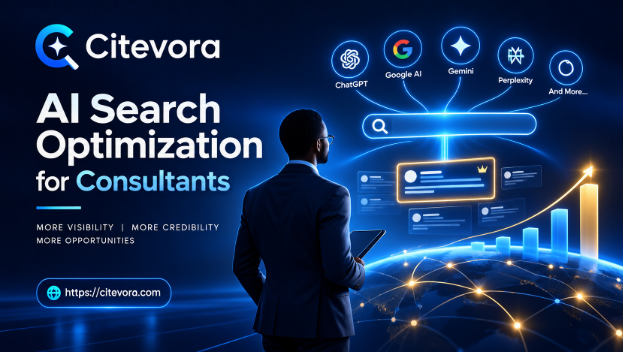
A buyer typing "who should I hire to fix our supply chain forecasting" into ChatGPT doesn't get a list of ten LinkedIn profiles to scroll through — they get two or three names, stated with confidence. AI search optimization for consultants helps you get named when a buyer asks ChatGPT "who should I hire" — before a referral ever happens. If you're an independent consultant and your name isn't one of them, the referral conversation that used to happen after a warm introduction is now happening without you, inside a chat window you can't see. That's exactly the gap AI search optimization for consultants is built to close.
The short answer: AI search optimization for consultants means structuring your website, case studies, and public credentials so that ChatGPT, Gemini, Perplexity, and Google's AI Overviews name you specifically — not just "a consultant" — when a buyer asks who can solve their exact problem, which increasingly happens before any referral or introduction takes place.
Key Takeaways
- 72% of B2B buyers now use ChatGPT at some point to evaluate vendors and service providers, while roughly half of B2B tech brands have zero AI citations at all.
- AI-generated answers typically name far fewer options than a traditional search results page, which makes the competition for a single consulting citation unusually concentrated.
- Consultants face a different optimization problem than companies do — the "brand" being evaluated is a person, which changes which credibility signals actually matter.
- Referral-based consulting practices are especially exposed here, since a referral increasingly gets silently verified or overridden by what an AI assistant says about you.
- Citevora applies the same multi-engine audit and content-implementation approach to individual consulting practices that it applies to larger companies, adapted for a solo or boutique-sized team.
What Is AI Search Optimization for Consultants?
AI search optimization for consultants is the practice of structuring a consultant's website, published work, and public credentials so that generative AI tools can confidently name that specific person when a buyer asks a related question — rather than describing the category generically or naming a larger, better-documented competitor instead.
This matters differently for a consultant than it does for a company. A company's website usually has dozens of pages, a marketing team, and years of accumulated content to draw on. A consultant's entire online footprint might be a single website, a LinkedIn profile, and a handful of guest articles — which means every page carries disproportionate weight in whether an AI model has enough signal to cite that person confidently.
AI search optimization for consultants is largely about closing that signal gap: making expertise, specialization, and track record explicit and easy for a model to extract, rather than leaving it implied across a thin set of pages.
This is closely related to what's sometimes called brand citations in ChatGPT tracking for companies, except the "brand" being tracked is a single person rather than an organization. That distinction changes what counts as a strong signal — a company can lean on a well-known name or a large existing footprint, while a consultant almost always has to earn citation through specificity and demonstrated results alone.
The urgency behind this shift is well documented. Forrester's 2026 B2B Buyer Journey research found that 72% of B2B buyers now use ChatGPT at some point to evaluate vendors, while Crackle PR's Q2 2026 AI Citation Benchmark found that 51% of B2B tech brands have zero citations across ChatGPT, Perplexity, and Gemini combined (Forrester and Crackle PR data, reported via MarketScale, 2026). For an independent consultant competing against both larger firms and other independents for the same buyer attention, that combination — high AI usage among buyers, low citation coverage among providers — represents a genuinely open opportunity for whoever gets there first.
Separately, research on how B2B buyers actually use ChatGPT during vendor research found that a significant majority of mid-market buying committees report using ChatGPT or a similar tool at some point in their evaluation process, with usage rates trending higher among younger buyers and technology-adjacent categories (Demand Gen Report coverage of G2's Answer Economy research, 2026). For a consultant whose ideal clients skew toward younger decision-makers or technical buyers — common in categories like IT strategy, digital transformation, or product consulting — that usage skew makes AI visibility even more consequential than the aggregate numbers alone suggest.
Why Consultants Need AI Search Optimization Now
Three dynamics make this more urgent for consultants specifically than for most other business categories. For more on this, see our AI search optimization service.
AI-generated answers name far fewer options than a search results page ever did. Where a Google search might return ten links for a buyer to sift through, a synthesized AI answer typically surfaces a much shorter list — often just a handful of names. For a consultant, that means the difference between being cited and not being cited is closer to a binary outcome than a ranking position, and the competition for that shortlist is more concentrated than traditional SEO competition ever was.
Referrals no longer happen in isolation. A prospective client who gets your name from a colleague increasingly still opens ChatGPT afterward to sanity-check that recommendation, ask about your specialization, or compare you against one or two alternatives. If an AI assistant can't find enough signal about you to say anything specific, that referral conversation can quietly stall or shift toward a better-documented competitor, even when the original recommendation was strong.
A consultant's entire credibility case has to live in far fewer pages than a company's does. A large company can afford some thin or outdated pages because dozens of strong ones compensate for them. An independent consultant with a five-page website has no such cushion — each page needs to carry real, specific signal, since there's little other content for an AI model to draw on when deciding whether to trust and cite that person.
Consultants beginning this process often start with a broader AI search optimization services engagement to understand where they currently stand across all four major AI platforms before deciding which specific pages need the most attention.
How to Evaluate an AI Search Optimization Approach for Your Consulting Practice
Whether you're doing this yourself or bringing in outside help, use this checklist to judge whether the approach is actually built for a consultant's situation rather than a repurposed company template. Our AI visibility score guide covers the specific metrics worth asking any provider about. For more on this, see our AI search strategy service.
- Does it audit citations for your name specifically, not just your firm or category? A consultant needs to know whether ChatGPT and Gemini can name them individually, which is a different and more specific question than whether the broader category gets mentioned.
- Does it map your specific niche and specialization, not a generic "consultant" positioning? A buyer's question is almost always narrower than "consultant" — the audit should test the specific, narrow questions your actual prospects ask, not a broad industry-wide phrase.
- Does it account for how thin a solo practitioner's site typically is? An approach built for a hundred-page company site will misjudge what "enough content" looks like for a five-page consultant site, and may recommend work disproportionate to what a solo practice can realistically execute.
- Does it address your presence beyond your own website? LinkedIn, guest articles, podcast appearances, and speaker bios all contribute to the credibility signal a generative engine draws on for an individual in a way that matters less for a larger company with its own dominant domain.
- Does it include actual content rewriting, not just a diagnostic report? A solo consultant rarely has a content team to hand a report off to — the value of an engagement drops sharply if the actual page rewrites aren't part of the deliverable.
- Does it help you write case studies that read as citable evidence, not just marketing copy? A results-focused case study with specific numbers and a named client problem is far more citable than a generic "we helped a client succeed" narrative.
- Does it recognize which credibility signals matter most for an individual? Author bio depth, demonstrated specific expertise, and consistent professional information across the web weigh differently for a person than for a company brand.
- Is the pricing realistic for a solo or small consulting practice? An enterprise-scale retainer built for a company marketing budget doesn't fit most independent consultants' economics, and a provider unwilling to scale pricing down accordingly may not be the right fit.
- Does it include a plan for ongoing monitoring, since a single competitor updating their own site can shift who gets cited for a shared niche question within a single quarter?
- Can it explain, in plain language, why you specifically aren't being cited yet? A generic visibility score with no specific diagnosis doesn't give a solo practitioner enough to act on with limited time and no content team to delegate the fix to.
Comparison: DIY vs. Generalist Marketing Help vs. Citevora for Consultants
| Approach | Typical Monthly Cost | Understands Solo-Practice Constraints | Individual Credibility Focus | Content Implementation | Best For |
|---|---|---|---|---|---|
| DIY, self-managed | $0 | N/A — you set the scope | Depends on your own knowledge | Yes, if you have the time | Consultants with strong writing skills and spare hours |
| Generalist marketing freelancer or agency | $500–$2,000 | Often built for companies, not individuals | Rarely a specific focus | Sometimes | Consultants who already have a marketing relationship in place |
| Full-service AI search optimization (like **Citevora**) | Custom, scaled to a solo practice | Yes, built around individual credibility signals | Yes | Yes | Consultants who want the audit and the content work handled together |
For more on this, see our AI visibility audit service
The middle row is worth a closer look, since it's where many consultants end up by default simply because they already have a marketing relationship for something else. A generalist marketing freelancer who's excellent at social media management or a basic website refresh may have no framework at all for what makes an individual citable to a generative engine, which is a genuinely different skill than general marketing competence. This gap mirrors what we've seen across the broader best answer engine optimization agencies landscape more generally — plenty of capable marketers exist, but genuine AI-citation expertise, especially applied to an individual practitioner rather than a company, is still a narrower specialty than the marketing industry as a whole.
10 Steps to Get Your Consulting Practice Cited by AI Search Engines
Run through these in order, whether you're doing this yourself or directing someone else to do it for you.
- Ask ChatGPT, Gemini, and Perplexity the exact question a prospective client would ask. Try "who should I hire for [your specific specialization]" and close variants, and note whether you're named, and who is named instead, and in what order.
- Audit your own site for how clearly it states your specific niche. If a stranger reading your homepage for thirty seconds couldn't state your specialization back to you precisely, an AI model is having the same difficulty extracting it.
- Add a clear, snippet-ready statement of your specialization near the top of your homepage. A 40–60 word description of exactly who you help and with what problem is what AI models lift most reliably — see our guide on how to appear in AI Overviews for the specific structure that performs best.
- Turn your best client results into specific, citable case studies. Name the problem, the approach, and a concrete outcome — "reduced client's forecast error by 22% over two quarters" is citable in a way "delivered great results" is not.
- Make your credentials and background verifiable and specific, not just a list of vague accolades. Certifications, prior firms, years in a specific niche, and named publications all give a model concrete detail to cite.
- Keep your professional information consistent across your website, LinkedIn, and any directories or bios you appear in. Inconsistent details about your background or focus area can quietly undermine the credibility signal a model relies on.
- Build a small cluster of content around your specific niche, not just a single About page. Three to five pieces addressing the specific problems your ideal clients actually have signal topical depth that a single strong page cannot on its own.
- Track whether you're being cited on a regular basis, since a single competitor updating their own positioning can shift who gets named for a shared niche question within a single quarter.
- Revisit your positioning periodically as your practice evolves. A niche description that was accurate two years ago may no longer reflect your current specialization, and an AI model has no way to know that unless your content reflects the update.
- Treat this as an ongoing part of your practice, not a one-time website project. A AI visibility score tracked over time tells you far more than a single audit ever will, and if you're comparing outside help against a wider field of options, our overview of the best GEO SEO company landscape is a useful reference point.
How Citevora Helps Consultants With AI Search Optimization
Citevora applies the same core process to individual consulting practices that it applies to larger companies — a multi-engine citation audit across ChatGPT, Gemini, Perplexity, and Copilot, mapped against the specific questions a consultant's ideal clients actually ask — adapted for the reality that a solo or boutique practice has far fewer pages and far less content-team bandwidth than a typical company client. For more on this, see our client testimonials.
From there, the work centers on the pages that carry the most weight for an individual practitioner: the homepage positioning statement, a handful of case studies rewritten to read as citable evidence rather than marketing copy, and a credibility-signal check across the consultant's website, LinkedIn presence, and any external bios or directories. Founder and CEO Israel Acheampong built this adapted approach after recognizing that most AI search optimization frameworks are designed around a company's much larger content footprint, which simply doesn't translate cleanly to a solo practice with five or six pages total.
Our experience working with independent consultants and boutique advisory practices shows a consistent pattern: the fastest citation gains come from rewriting the two or three pages that already carry the most potential signal — usually the homepage and the strongest case study — rather than trying to build an entirely new content library from scratch. For consultants who've already formalized a broader plan, our guide to AI search strategy services covers how that prioritization and sequencing work applies more generally, and the AI search optimization services page outlines how a consultant-focused engagement is typically scoped.
This adapted, page-prioritized approach reflects something we've learned specifically from working with solo practitioners rather than companies: a consultant rewriting five pages well will typically see a faster, cleaner citation gain than one trying to build twenty mediocre pages in the same amount of time. Depth on a small number of high-signal pages consistently outperforms breadth across a large number of thin ones for an individual practitioner, even though the opposite can sometimes be true for a company with a larger content team and a broader set of buyer questions to answer simultaneously.
We also draw on perspective from the wider top experts in generative engine optimization field when a consultant's niche is especially specialized or technical, since the credibility signals that matter for, say, a regulatory compliance consultant differ meaningfully from what matters for a marketing strategy consultant, even though both are solo practitioners facing the same underlying visibility problem.
Common Mistakes Consultants Make With AI Search Optimization
- Describing yourself as a generalist to avoid narrowing your market. A homepage that says "I help businesses grow" gives an AI model nothing specific to cite; a page that says "I help mid-market manufacturers reduce inventory forecasting error" gives it something concrete to lift when a buyer asks that exact question.
- Treating your LinkedIn profile and website as separate, unrelated assets. Inconsistent descriptions of your specialization across these two surfaces can quietly confuse the credibility picture a generative engine assembles about you.
- Writing case studies as testimonials instead of evidence. A glowing quote from a happy client is nice to read but gives a model little specific to cite; a case study with a named problem, approach, and measurable outcome is what actually gets lifted into a synthesized answer.
- Assuming a referral-based practice doesn't need this work. As noted above, a referral increasingly gets checked against what an AI assistant says before a prospect reaches out — a strong referral pipeline doesn't insulate a consultant from this shift, it just delays when the gap becomes visible.
- Waiting until business slows down to address this. It's tempting to deprioritize AI search optimization while a referral pipeline is still strong, but the content and credibility work described in this guide takes weeks to show results — a consultant who waits until referrals dry up before starting has already lost the head start that made the difference for competitors who began earlier.
- Running one audit and never revisiting it. A consulting niche is a moving target — competitors update their positioning, new specialists enter the space, and a citation you won a year ago isn't guaranteed to hold without periodic AI LLM SEO audits to check whether it still does.
How to Measure Whether AI Search Optimization Is Working for Your Practice
Track progress across roughly this timeline after making changes to your site and public credentials, and see our AI LLM SEO audits page if you'd rather have this measurement handled for you.
- Weeks 1–4: Re-run the specific buyer questions from your baseline audit and check whether you're now named where you weren't before, or named alongside fewer competitors than in the original check.
- Weeks 4–8: Watch for an increase in prospects who mention having "looked you up" or reference specific details from your site during an initial conversation — a sign the AI-assisted research phase is now working in your favor rather than against it.
- Weeks 8–12+: Track whether inbound inquiries that didn't originate from a direct referral or existing relationship start to increase, since this segment is the clearest signal that AI-assisted discovery is generating new opportunities on its own.
For a referral-heavy practice, it's also worth simply asking new clients directly during onboarding whether they looked you up using an AI assistant before or after the referral — the answer often reveals how much of your existing pipeline is already being quietly influenced by this shift, even if you haven't changed anything yet.
It's worth resisting the temptation to treat a quiet first month as a sign the work isn't paying off. Citation gains for an individual practitioner often lag slightly behind what a company sees, simply because generative engines take a bit longer to build confidence in a smaller, less-established entity even after the content itself has improved. A consultant who reruns the same baseline questions monthly, rather than checking once and giving up, is far more likely to catch the gradual shift as it happens rather than concluding too early that the work didn't work.
For an independent consultant, getting cited by an AI assistant isn't a replacement for referrals and reputation — it's what increasingly happens in the background of every referral, whether you're paying attention to it or not. The consultants who get specific about their niche, turn their results into citable evidence, and keep that work current are the ones who show up in the answer, not just in the conversation that led to it.
Citevora adapts its full multi-engine audit and content-implementation process specifically for solo and boutique consulting practices, focused on the handful of pages that actually carry the weight of your credibility online. If you want to see exactly what ChatGPT, Gemini, and Perplexity currently say — or don't say — about your specific practice, get in touch and we'll walk you through it.
About the author: Israel Acheampong is the Founder and CEO of Citevora, an AI Search Authority company helping consultants, B2B SaaS companies, local businesses, and enterprise brands become the source AI engines cite. He has spent years working across web design, SEO, and generative-engine optimization for clients across the US, UK, Canada, Australia, and China.
Frequently Asked Questions
-
What is AI search optimization for consultants? AI search optimization for consultants is the practice of structuring a consultant's website, case studies, and public credentials so that ChatGPT, Gemini, Perplexity, and Google's AI Overviews name that specific person when a buyer asks who can solve their particular problem.
-
How is this different from AI search optimization for a company? A company's website usually has far more content and pages to establish credibility; a consultant's entire online footprint is often just a handful of pages, which means each page needs to carry more specific, concrete signal for an AI model to confidently cite that individual.
-
Do referral-based consulting practices really need to worry about this? Yes — a growing share of referrals get informally checked against what an AI assistant says about a consultant before the prospect reaches out, which means weak AI visibility can quietly undercut even a strong referral pipeline.
-
How long does it take to see results from AI search optimization as a consultant? Most consultants see initial citation movement within four to eight weeks of rewriting priority pages, with a noticeable shift in inbound inquiries not tied to direct referrals typically visible by the eight-to-twelve-week mark.
-
What's the single highest-impact change a consultant can make? Replacing a generalist positioning statement with a specific, narrow description of exactly who you help and with what problem tends to produce the fastest visible change, since it gives an AI model something concrete to extract and cite.
-
Can a solo consultant do this without hiring help? Yes, using the ten-step framework outlined above, though most solo practitioners find it faster and more consistent to pair the work with outside support specifically because they have limited time to dedicate to ongoing content revisions.
-
Do case studies really matter for AI citation, or just for human readers? Both — a specific, results-focused case study with a named problem and measurable outcome is exactly the kind of concrete detail generative engines favor when deciding what to lift into a synthesized answer.
-
How much does AI search optimization cost for an independent consultant? Pricing scales with practice size, but a full engagement including an audit and content rewrites for a solo practice is typically far below what a company-scale engagement would cost, since the content footprint being optimized is much smaller.
-
What makes Citevora's approach different for consultants? Citevora adapts its standard multi-engine audit and content-implementation process specifically for the reality of a solo or boutique practice, focusing on the handful of highest-impact pages rather than applying a company-scale content framework.
-
Does LinkedIn matter for AI search optimization as a consultant? Yes — LinkedIn, guest articles, and other public mentions all contribute to the credibility signal a generative engine draws on for an individual, so consistency between your LinkedIn profile and your website matters more for a consultant than for a larger company brand.